Wednesday, January 11, 2017

Jacket Repair, Table Saw Switch


My brother got a hole in the shoulder of his jacket while he was playing bocce or tetris battle or something. I patched it with a scrap of nylon. The patch is shaped to just cover the holes.


I also installed a new switch on an old Rockwell Unisaw. It's a bit out of the way by request of the owner.


I will post more photos of this saw after I install the new fence.

Tuesday, January 3, 2017

Brass Knobs


I made 60 Ø 5/8" (16 mm) brass knobs for furniture my dad makes. These knobs are for a dresser and a sideboard. They are tapped 10-24 on the backside as deep as I dare, finished with a bottoming tap, for ease of installation. Although they are very simple, the clean lines stand out. They also radiate qualities of solid brass to me, somehow it's clear they aren't plated. I think it's a result of the flatness of the top surface and well-defined profiles.

In any case, they aren't much of a machining challenge but we do like the way they look.


The matte ones are after abrasive finishing, the finished product.


Sunday, January 1, 2017

Coat Buttons Repair


The buttons started falling off my coat. It looks like they were hand sewn originally, and my heart goes out to the person who has to sew 400 buttons a day for a pittance. I only had to sew ten and I'm already blogging about it to soothe my ego.


The real purpose of this post was to show my materials of choice for durable repair sewing:
  • Waxed linen- I got a pretty sizeable spool from McMaster (Item No. 3858T13). Really pleasant to work with, does not tangle easily.
  • W. Smith and Sons needles- also a pleasure to use. They are expensive but this type of thing pays for itself after a single use (in the U.S. anyway)
  • Sailmaker's palm- buy it or make it. I got a W. Smith one and it works great, the quality is nothing to write home about though.
  • Needle puller- pliers work, but I use a piece of rubber or leather. Often hard to get the head of the needle through the material without something to grip the smooth needle body with.  


Happy repairing-

Sunday, December 25, 2016

Gift Wrapping


I made this box thing for a Christmas present. It is made from a square of heavy manilla paper. A thinner piece of paper would have been easier to work with.

I drafted the pattern directly onto the paper using the drafting machine and compass. While drawing the dozens of arcs, I discovered that my 70's(?) Alvin Speed Bow has slop in it! I had previously assumed it was moving due to operator error. You can see the resulting double lines in the image below.


A really good compass is hard to find, especially now. Ebay is ripe with vintage ones, but few look inspiring. The Starrett 92-6 looks nice with the exception of its threads. It might just be the sort of tool I have to make myself. I just want one that's quick to adjust and SOLID when set.

Maybe like this. I already want to re-draw it... the side view is ugly. Important parts are: Big ol' sharp knurled thumb nut to lock adjustment, mated with shoulder screw going through a tight slip fit in the arms. Greasy O-ring to provide some resistance when adjusting. Thoughtful clamps to lock the graphite and center point in place, maybe only one per side, but not with the standard pathetic 0-80 locking screw. While we're dreaming, the arms should be hardened tool steel with the sliding surfaces ground.


Sorry, I got distracted.


Wish I would have figured out how to make it hold itself closed, some sort of interlocking flaps. Maybe next Christmas.


Tuesday, December 13, 2016

Waterstone Holder, Snowflakes


I've gotten a lot of sharpening work recently, which is why I haven't been posting much. I do most of the sharpening with waterstones and oilstones. I have a makita wet grinder which is great for jointer knives, but it is less aggressive than a coarse 'unpowered' stone.
It's been a test of patience to take nicks out of hundreds of knives by hand, but a belt grinder is finally on its way. Although it will take me a while to put together, it'll be dressed right up with a VFD, coolant mister, and purpose-built stand. I may sort out some dust collection as well.

I just made this adjustable waterstone holder to hold the stones properly above a tub of water.


Also made some paper snowflakes:


Below, a part of a wooden prototype done on commission. I'm making prototype parts out of wood, which is a really great material for low-budget design testing. The rejected designs work great as firewood, unlike plastic or aluminum.


Saturday, November 12, 2016

Pulaski Axe Sheath, More Spoons


I finished sharpening this pulaski axe for a customer. When I get items to sharpen without any edge protection, I generally return them with a sheath or similar. I started making a cardboard sheath for this, but it seemed too nice a design to be cut off and thrown away. I traced it onto a piece of leather to make the sheath pictured. I'd normally sew it together, but this tool leads a rough life in a garden shed. Rivets will do.


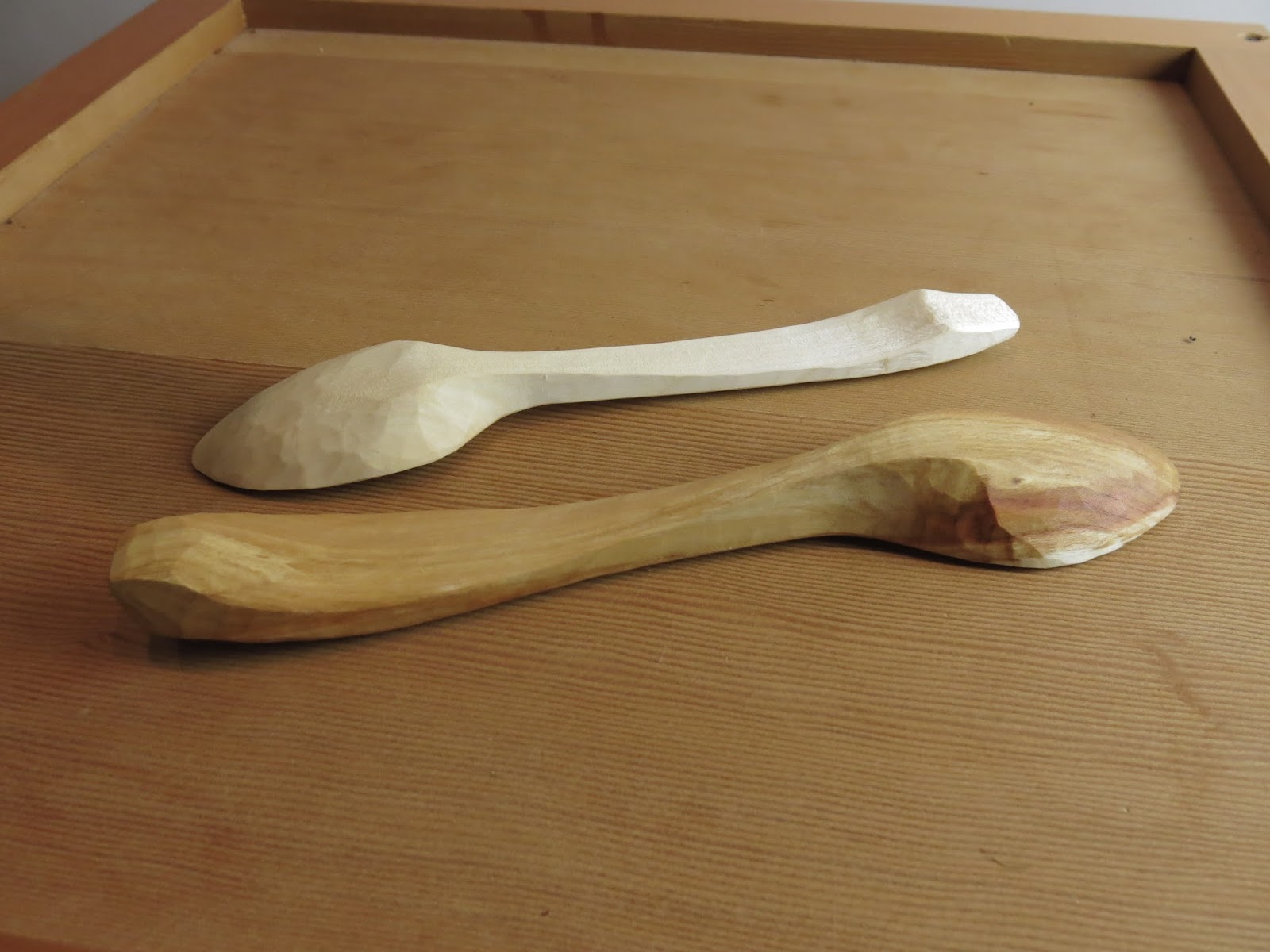
A recent wind storm gave me a maple and a mystery wood log. I started carving spoons from them. Both around 10" in length. The maple spoon is my favorite one yet.


Monday, October 24, 2016

Mora 163 Hook Knife Modification


I have a Morakniv 163 hook knife, which isn't the best knife but it does work. I thought I'd try to improve it instead of buying or making another. Above and below are pictures of the knife more or less as it came new.


Below, the re-ground blade. It's less prone to catching and more predictable, though the handle is still too short and the blade ought to have a thicker profile. It definitely does the job though, and better than before.

I did the grinding with a Makita 9820-2, a 220 grit aluminum oxide stone, 320 and 600 grit sandpaper, and Metal-glo on a piece of balsa.

To sharpen it and all my carving tools quickly I just use a 1200 grit aluminum oxide stone with sewing machine oil, followed by dia-paste on a strop. A light touch with the stone keeps a large un-strop-able burr from forming. I could (and sometimes do) use finer grits to get a sharper edge, but it seems counter-productive when the edge loses that extra sharpness after 30 sec. of use.


Maple spoon blanks: